The sweet spot for school trips: What time is right to unlock the biggest benefits for students?
- Friday January 16th 2026
- LEGOLAND® Windsor Resort

Far from simply a fun day out, school trips are a tried-and-tested way to bolster education.
A carefully planned trip can bring abstract concepts to life; a change in environment adds novelty and sparks curiosity; a chance to learn outside the classroom can deepen understanding of a topic; and then there’s the positive impact on confidence, social skills, independence and cultural capital.
We could go on.
At LEGOLAND® we see first-hand how students’ excitement as they explore the park translates into intrigue about topics, principles and ideas that they’d only see otherwise in a textbook.
However, to really unlock these potential benefits, it’s critical to get the timing right.
There’s no one-size-fits-all here, of course.
But, when you’re planning a trip it’s helpful to map out how a trip fits into the wider programme of learning, what objectives it helps deliver and what point in that programme therefore makes sense.
Here are a few different options.
AT THE START
A school trip used as a starter activity for a new topic can be a fantastic way to get students excited and energised about an area of learning that may otherwise feel a little abstract.
A children’s science project focused on mechanical systems may be difficult to grasp in a textbook, for example. But kick-off that programme of learning with a trip to LEGOLAND, and students can stand back and watch the powerful impact of gears and pulleys as they allow our rides to start, slow, speed up and stop, before the chance to build their own mechanical LEGO® model in our tailored Gears & Pulleys workshop. They’ll finish the day far more excited about what’s to come.

The trick here is to wring all you can out of a trip rather than let it fade in students’ memories and make it a core component of all subsequent lesson planning.
Take the above example. Follow-up on what students saw as they explored the park by asking them to explain the mechanics at work in their favourite ride. Or get them to design their own, signposting how gears, pulleys, wheels and axles make each turn and pivot possible.
You could even turn a school trip into the overarching theme of a cross-curricular project. A trip to LEGOLAND could feed into everything from constructing models in Design & Technology, to mapping out famous landmarks in Geography or inspiring a host of science experiments for kids in robotics, forces and sustainability.
MIDWAY THROUGH
Breaking up a programme of learning with a school trip at the midway point is a second option.
In this timeline, a trip is about cementing ongoing learning before it’s further expanded upon in the classroom. Taking a topic outside the classroom in this way can really help to deepen understanding and bring ideas to life in a way that solidifies what may be tricky concepts.
Students may already have navigated some of the basics of coding, for example, using ‘unplugged’ methods like coding mazes, delving into bitesize explainer videos or experimenting on popular online platforms like Scratch.
But before they take that next step in the curriculum, they can deepen their learning through play and collaboration at LEGOLAND by attending one of our primary or secondary Robotics workshops. In both, they’ll get hands-on with our LEGO Education STEM kits such as SPIKETM to do everything from write and debug programs (KS1-2) to designing their very own robots (KS3).
Once again, make sure a school trip midway through a programme of learning feels seamless by embedding it in learning both before and after the trip.
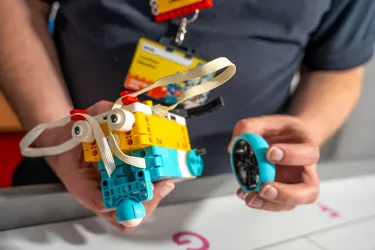
Introduce LEGO education kits in the lead-up to the trip to get that excitement bubbling and connections firing or integrate the idea of theme parks, rides and rollercoasters across multiple subjects, from Maths to Geography and even creative writing.
Post-trip, build upon what students have learned before the excitement fades. Create a visual memory wall of what they saw and experienced, ask them to share their favourite fact from the workshop or present what they created to the rest of the class. Use this as momentum as you approach the tail end of a topic, where more complex learning comes into play.
AT THE END
The third choice is to use a school trip at the end of a programme of learning.
It’s perhaps the most common, and it’s easy to see why.
A trip as an end-of-term activity can act as a brilliant incentive for students as they work through what may be a complex or challenge topic area, it’s a goal for them to work towards and feel excited about.
But the secret is not to position a school trip as an unrelated reward to blow off steam after a tough term. Instead, make it a consistent culmination to a wider project.
Rounding off a rollercoaster-themed science project with a day out at LEGOLAND, for example, carries so much more value. Before they’ve even set foot through our gates, students may already have mapped out the forces at work on their favourite rides, thought about the energy transfers taking place as they hurtle down steep drops aboard The Dragon or even compared our creations with their own designs.
In this way a school trip becomes the perfect plenary activity – a chance to reflect and evaluate what they’ve learned and cement learning – as well as an adrenaline-fuelled adventure to reward them for all their hard work, of course.
Whatever timing strikes the right chord for you and your class, make sure you unlock maximum benefits from a school trip to LEGOLAND by embedding it into each stage of learning: before, after and even during the trip itself.
By doing so students have an unforgettable day out – but absorb knowledge and understanding that’ll stay with them for much, much longer.
