How the science of rollercoasters makes an awesome theme for KS3
- Friday January 16th 2026
- LEGOLAND® Windsor Resort
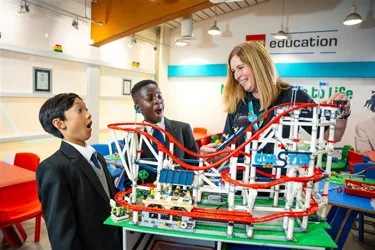
That rush you get when you step off a rollercoaster is like no other.
The speed, the sounds, the sight of the ground rushing toward you as you hurtle down sudden drops, round dizzying loops and hidden corners.
But at LEGOLAND® we know that rollercoasters are so much more than a thrilling ride.
Meticulously designed using a complex understanding of forces, friction, motion and energy, they can be an invaluable educational tool too, taking what may feel like dry or abstract concepts, and bringing them to life for students in vivid, dizzying detail.
There are so many benefits. A rollercoaster theme can provide secondary-age pupils with a thrilling way to explore complex scientific principles through play and investigation; help tricky information ‘stick’ thanks to higher levels of emotional engagement; and pique cross-curricular curiosity, questions and ideas that reverberate long after a science lesson has ended.
And, of course, it makes the perfect backdrop for an unforgettable school trip to LEGOLAND where students can climb aboard one of rides to see the scientific principles they’ve learned in action and take advantage of our award-winning on-site workshops at the same time.
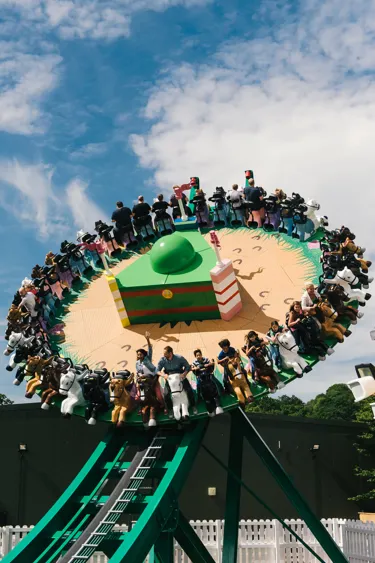
Here are a few ideas on how to embed a rollercoaster theme in your next lesson plan.
FANTASTIC FORCES
Physics is the sweet spot when it comes to a starting point for your rollercoaster-themed project, with almost endless connections to be drawn with the KS3 curriculum.
You could use rollercoasters as the launchpad for learning about contact and non-contact forces. Challenge students to think about how both play a role in pulling a carriage up, down and around the track, annotating force diagrams with the various stages at which gravity, friction, air resistance and acceleration are taking over and what job they do.
Or how about tracking the various energy stores and transfers at each stage of the ride? From the top of that first drop, to its rapid descent, use simple diagrams to calculate the conversions between gravitational potential energy (GPE) and kinetic energy (KE).
And, of course, gravity. Forget the tired old story about an apple falling on Isaac Newton’s head. Instead, use a steep drop aboard a rollercoaster to illustrate the point. You could even tie it to learning around Space and orbits, using ‘airtime’ (that sense of weightlessness) aboard a rollercoaster to introduce the concept of free-fall and why astronauts float.
The great thing about a rollercoaster theme is its flexibility makes it the ideal link between the KS2 concepts that students are already familiar with, and that little stretch in learning that’s required for KS3.
For example, you could use rollercoasters to refamiliarize students with simple ideas of what forces are and how they work (KS2) before following a carriage along the track to build on that foundation, introducing the concepts of acceleration, motion and also resultant forces, i.e., what happens when two or more forces are applied (KS3).
CROSS-CURRICULAR INSPIRATION
The usefulness of rollercoasters as an educational tool doesn’t begin and end in the science classroom, of course.
Think of them instead as a (thrilling) bridge to other core KS3 subjects, topics and skills.
Get students to apply the geometric principles they need to learn as part of KS3 Maths to the design of a rollercoaster track. Calculate the radius and diameter or curvature of loop the loops; apply the concept of banking angles to tight corners; and think about the mathematic principles that an engineer or designer might apply to achieve the right speed and ensure riders are comfortable.
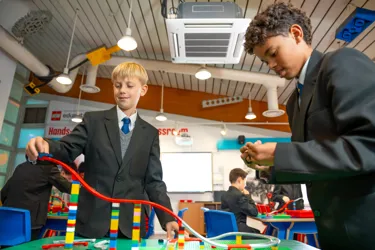
Wear that same engineer’s hat in Design & Technology class. Students could construct their own rollercoaster designs using basic materials like paper, card or pipe-insulation, working in groups to debate which designs have the most stable structure and safety for riders.
And all this could feed into Geography, as students pick apart the environmental considerations when designing a rollercoaster and put them in the context of a theme park, exploring its role as a major tourist attraction.
By using a rollercoaster theme to blur subject boundaries and create a coordinated programme of learning, students develop a deeper, more comprehensive understanding, make connections and identify patterns, as well as practising skills like critical thinking and problem-solving.
AN UNFORGETTABLE SCHOOL TRIP
Of course, any great rollercoaster-themed project includes the chance to climb aboard the real thing and give it a whirl.
Pairing a cross-curricular project with a school trip is a tried-and-tested way to cement what students have learned, get them thinking about real-world connections and, crucially, feeling excited and energised.
At the LEGOLAND Windsor Resort, they can climb aboard The Dragon and feel the forces at work as they ride slowly through a Medieval castle and past a fire-breathing dragon, before succumbing to gravity on our thrilling outdoor track, reaching speeds of up to 50 km/h.
Or take a trip on our newest addition: Minifigure Speedway. The world’s first LEGO®-themed duelling rollercoaster hurtles both forwards and backwards – a high-octane demonstration of physics at work that’ll leave students thoroughly intrigued.
The journey doesn’t stop once they step off a rollercoaster either.
As part of your school trip itinerary take advantage of our award-winning tailored workshops to take that learning outside the classroom to the next level.
In our Science of Rollercoasters session, one of our highly trained facilitators will walk students through the energy transfers they’ve just experienced first-hand and how a mix of gravity, friction, air resistance and centripetal force help get them round a loop the loop, before working in groups to build their own LEGO model rollercoaster.
Rollercoasters are thrilling feats of engineering with so much to dissect inside and outside a theme park. And with applications across multiple KS3 subjects and topic areas, they can turn any lesson plan or project into an adventurous ride students won’t forget anytime soon.
